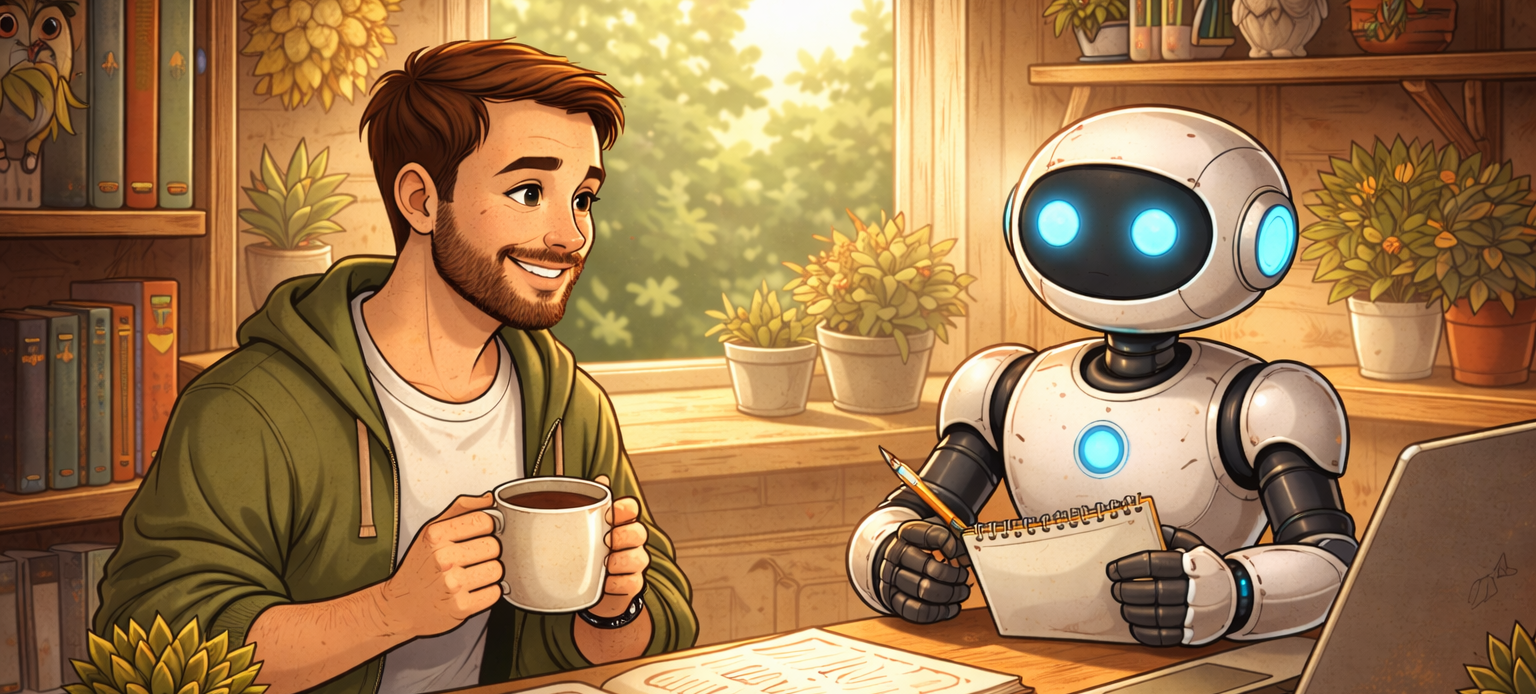
Using AI as a Sounding Board
There’s a lot of talk right now about writers using AI, and most of it assumes the same thing: that the machine is doing the writing. That isn’t how I use it.
For me, it’s more like a sounding board.
Writers have always done this. You bounce ideas off a friend, a writing group, or an editor. Sometimes you just talk through a story out loud until it starts to make sense. AI just happens to be available any time of day, and it doesn’t get tired of half-formed ideas.
When the idea for this book first started forming, it wasn’t a story yet. It was more like a pile of thoughts I’d been doodling with. I opened ChatGPT and typed this:
“I want to create a futuristic story involving a valley in the future where the world has been devastated and the story focuses on animals, and more directly, coyotes. The coyotes have survived in this valley where many other larger predators have died off for lack of big game. The coyotes have survived because they can live off smaller game, and historically they have been shown to be almost impossible to get rid of due to their spreading out and using many burrows.
The problem is mankind. They want to repopulate this area by means of breeding programs and they release hundreds of deer into the valley. Despite what seems to be a good thing, not only do the deer destabilize the ecology, they also bring back the wolves who have until now avoided this valley for lack of large game. I have no idea where the wolves have been until now.
I want the coyotes to show their traditional pack behavior. I'm not sure where to go with the story, but I know it involves a young female coyote who is taken in by the main pack when wolves wiped out her own tribe. Can you give me an outline of what I have told you, and some idea where to go with the story and name some of the main characters?”
That was it. No polished concept. No outline. Just the basic pieces of an idea.
Now, if I had simply asked it to write the story, what I would have gotten back probably would have been a few pages. Maybe a short story. Something quick and tidy that wrapped itself up in a neat little ending.
Certainly not a 500-page novel.
What it actually helped with was organizing the mess in my head. It suggested directions, pointed out things I hadn’t thought about yet, and helped me see what the bones of the story might look like.
From that rough conversation eventually grew Ember- The Coy-Wolf Chronicles.
Why I Like Using AI This Way
Used like this, AI isn’t a ghostwriter. It’s more like a notebook that talks back.
You throw ideas at it. Some are useful. Some are terrible. Most of them you ignore. But the process helps you see the story more clearly.
In the end the writer still does the work. The characters, the voice, the pacing, the worldbuilding — all of that comes from the author.
AI just helps you get past that moment when the idea is still foggy and you’re trying to figure out what the story even is.
Sometimes that’s the hardest part of writing.
Influence Is Not Theft
Another criticism I hear a lot is the claim that AI is somehow stealing from writers and artists. I’ve never found that argument very convincing.
No writer learns in isolation. Every author absorbs style, structure, pacing, and technique from the people who came before them. We read novels, study dialogue, admire how another writer builds tension, and then we go back to our own work and try to apply what we learned. Artists do the same thing. They study anatomy, composition, lighting, and the brushwork of painters who lived centuries before them.
That isn’t theft. That’s how creative fields have always worked.
Every writer carries a library of influences in their head. You might read Jack London, Tolkien, Cormac McCarthy, or a hundred others over the years. Their techniques shape how you think about storytelling, even if the story you eventually write is completely your own.
AI works in a similar way. It doesn’t copy someone’s book or someone’s painting and hand it back to you. What it produces is more like a reflection of patterns it has learned across enormous amounts of writing and art. The result is still something new, and more importantly, it still depends entirely on the person guiding it.
When I sit down to write, the story, the characters, the voice, and the decisions all come from me. AI can help me think through ideas, but it can’t replace the human part of storytelling any more than a thesaurus can replace a writer.
Creativity has always been built on influence. AI doesn’t change that. It just gives writers another tool to explore ideas.
In the End, the Story Still Has to Be Written
In the end, AI didn’t write my book.
What it did was help me think through an idea when it was still half-formed. It helped organize the pieces and gave me something to react to. After that, the real work began.
Five hundred pages of it.
Characters had to be developed. The world had to make sense. Scenes had to be written, rewritten, and sometimes thrown out completely. Dialogue had to sound like real voices. The story had to hold together from beginning to end.
No machine can do that part for you.
Writing a novel is still the slow process it has always been: sitting down day after day and building the story one scene at a time. AI can help you think. It can help you brainstorm. It can help you ask questions about your own work.
But the story itself still comes from the writer.
And in my case, it all started with a rough idea about coyotes surviving in a valley after the world had fallen apart.
Everything else grew from there.