THE BIRTH OF A WORLD
This story did not begin at a desk. It began in the desert. I knew pretty early that what I had was not a novel… not even a story; It was a fragment.
My brother and I were living in Quartzsite, Arizona then. We’re nomads living off the grid all around the west coast camping where we could, but We could stay six month in one place only… the desert.. Long horizons. Sparse noise. The kind of stillness that makes small sounds feel deliberate.
One evening 12 coyotes circled somewhere out in the dark, maybe a hundred feet from camp, and began howling together. Not scattered yips. Not random. A chorus. Not one or two. Twelve. We pulled out flashlights and swept the dark. Everywhere the beams passed, pairs of eyes flashed back at us. Green. Gold. Silent. Watching. I wasn’t scared. Even close up they sound like a pack of puppies.
The coyotes howled for 5 minutes, letting us know they were there, then they disappeared. I remember thinking how coordinated they sounded. Not theatrical… purposeful. That image stayed with me.
The first version of this story was almost playful. Coyotes as protagonists. Restless, clever, slightly comic. I even imagined them singing a parody of “When You’re a Jet,” from West Side Story, only it was “When You’re a Yote.” It didn’t survive the drafting process. But it was the spark.
One thing you have when you are in the desert is think. I had something gnawing at me here. I knew my story would involve coyotes and wolves. It was a simple intuition. I knew wolves are in certain desserts. I also knew I wanted humans in the story. What I needed next was a pivot character, something the others might have trouble with for one reason or another.
The wolves were too strong to be fragile. The coyotes were too adaptable to be erased. Neither species felt vulnerable enough to anchor the kind of tension I wanted. So I created something that shouldn’t quite exist.
A cross between wolf and coyote.
I had seen videos of real coy-wolves… longer legs, leaner bodies, subtle genetic irregularities that made them look like evolution paused mid-adjustment. They were neither one thing nor the other. That was exactly what I needed. I didn’t have a story, much as it felt like one at the time. It was a scene... not even a serious one. It made me smile. It made me curious. But it had nowhere to live.
If I was going to keep them, I had to put them somewhere they could survive. I knew it was a place they would fight over.
At first it was just a valley. That was the start. It became so much more… way more than appeared in the novel… maybe someday I’ll talk about that. Everything added to a story has to be questioned. Why this… or why that? I knew the coy-wolf would be my “hero” but I needed a reason why she had to BE a hero. Hate was always the motivator and I realized it had to be racial… and half-breeds are usually a root of contention.
Why would this coy-wolf be hated strongly enough to justify trying to eliminate her kind?
I pressed at that question for hours. Wolves are proud. Coyotes are resilient. Pride in pack animals is not metaphorical. It governs territory, breeding rights, hierarchy. Under insecure leadership, pride can harden into purity. And purity, once invoked, demands removal of what complicates it.
That realization darkened the valley.
Around that time I began using early AI systems as a sounding board. Not to produce prose. Not to replace thinking. But to interrogate behavior. I would write a scene and then ask, would a wolf actually react that way? Would a coyote hold its ground? Would hunger override lineage? The answers were uneven. Sometimes shallow. Sometimes confidently wrong. It was like arguing with something brilliant but unfinished… a genius two-year-old that refused to stop asking why. Chatgpt was fairly primitive then. It had questions I needed answers for, again and again.
The friction forced clarity.
If I couldn’t defend a character’s motivation under questioning, it didn’t belong in the book.
After a year came the stroke. My stroke. I woke up one morning with my right side affected. Another kind of bleed would have taken me in my sleep… so I was “lucky”. Three days in the hospital, and months recovering basic movements like walking. I lost the use of 50 years of art training in my hand… I could feel it, but I couldn’t use it… my hand no longer worked that way. Typing took longer and I could control a mouse.
Recovery from a stroke does something direct… it doesn’t fool around. It strips away illusion. You either regain capacity or you adjust. Complaining doesn’t rewire neurons. Adaptation does. Not that I didn’t complain… I’m quite good at it, but it didn’t fix anything.
Eventually I got back to the story.
The valley evolved that way too. It waited for me to return, altered and slower, and I needed something that demanded my mind.
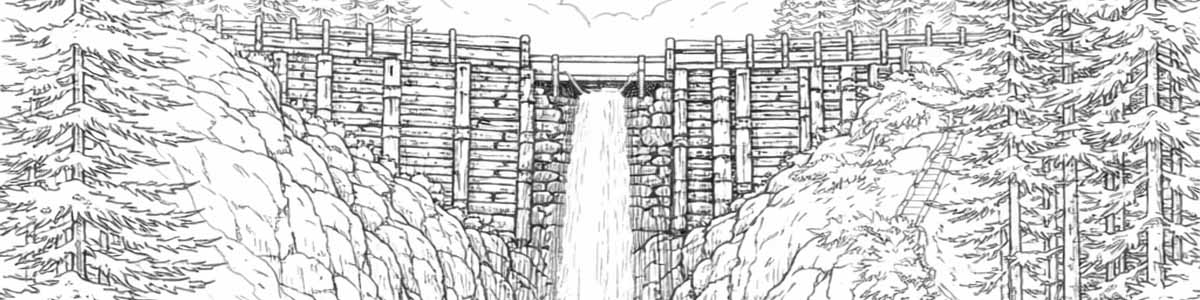
The dam was always there, I knew… it was essential to human development and survival. I knew humans would redirect the river. Humans build. They control. They intervene and call it progress. That part felt honest.
Then came the idea of the deer. It was a simple idea at first, but I didn’t at first realize how important that would be the development of the valley.
Fifteen years before the novel’s present, the humans revitalized the deer population in a valley that had grown thin on large prey. It seemed compassionate. Logical. Corrective.
But ecosystems are not spreadsheets. What looks good on paper is not always good if you don’t ask the right questions.
Prey returned. Wolves were attracted to the abundance… they even took part in saving the valley from its own overabundance. The wolves found abundance and stayed. The coyotes could have continued on small game. The wolves would not retreat from new territory once established. Pressure mounted.
That was one of those moments I chase as a creator… when separate ideas suddenly lock together. Deer. Wolves. Purity rhetoric. Hybrid vulnerability. Human intervention. The dam constricting water flow. None of it stood alone anymore. The humans did not really know. As is so often the case, they believed they were correcting something. The animals felt the consequences immediately.
I kept having to find a way to pull the story altogether. Above it all, something had to represent balance.
The Great Mother began as background. A symbol. A spiritual presence that could draw Ember away at the right moment and remind the valley that excess carries cost. She was never meant to perform miracles. Her power is narrower than that. She alters understanding. She reveals history. She knows what has been buried… sometimes literally, sometimes morally.
“I keep the balance.”
That line felt less like theology and more like ecology.
The more I developed the valley, the more it behaved like a system. The dam had always been there. Humans would redirect water. That felt honest. But something larger needed to explain how humans and animals were entangled so completely.
The pandemic was unfolding in the real world while I was writing. Entire systems stalled. Supply chains fractured. Cities quieted. The idea of a global collapse no longer felt abstract.
In the valley’s history, a few thousand humans survived by sealing themselves into a technological underground structure. Self sustaining. Stocked with preserved knowledge. A last effort to keep something alive while most of the world died off. They waited. They studied. They planned a return.
But how would they know when it was safe?
That is where the ark idea formed.
The deeper history of the valley formed around what I began calling, privately, the Noah Project. If humanity had sealed itself underground while a pandemic burned across the surface, it would not simply wait and hope. It would test. It would design something capable of leaving the shelter, crossing unstable terrain, surviving radiation or scarcity, and most importantly, returning information.
Coyotes were already adaptable, already intelligent, already capable of thriving in harsh environments. Wolves carried strength, coordination, and territorial instinct. A hybrid, drawn from preserved genetic stock and altered just enough to expand perception and communication, made unsettling sense. They were not meant to be weapons. They were meant to be scouts. Bridges. Living instruments sent into an uncertain world to determine whether it was safe for humanity to emerge again.
Of course, desperation rarely produces clean outcomes. Experiments escape.
Seventy-five years later, the humans have forgotten much of what they once knew. Literacy erodes. Technology decays. But the valley remembers. Consequences do not expire on schedule.
Working on this world while adapting to my own altered body felt strangely consistent. The rules had changed. The old methods didn’t function the same way. So I found new ones. Digital tools. AI-assisted iteration. Slow reconstruction. Not shortcuts… adjustments.
The story gave me something to push against.
Here is a particular exhilaration when separate ideas suddenly converge. When unrelated fragments collide and produce coherence. It feels like a spark jumping a gap. A sudden internal flash where everything aligns at once. That is the moment I chase. That is the big bang inside the mind.
It’s the same response I had listening to coyotes in the dark. Something coordinated. Something purposeful. Something larger than any one voice.
The world outside had kept evolving. Everything wanted life the way that way that was best for them. In the end, it was inevitable that the valley would fracture into alliances and enemies. Some wanted dominance. Some wanted survival. Some simply wanted to be left alone.
When I first started I thought maybe children would like what I was initially working on, but then I saw the violence just for animals to live day to day and thought better of it.
From the outside, the desert was still. Inside, the valley was alive, and I suspect it still is. I have a feeling this world is not finished with me yet.